The Languages master file is used to define what language is used by the patient. Languages are a predefined global table containing the 2-character ISO 639-1 language codes (available in Centriq v12 for Meaningful Use Stage 3) and 3-character 639-2 language codes.
Language codes in this master file are available in the required Preferred Language field in the MPI screen, available in various applications. The following language codes must be available for selection to comply with Meaningful Use reporting requirements:
- OTH - Other: Use when a valid code cannot be found in the master list.
- UNK - Unknown: Use for unknown information.
- DTS - Declined to Specify: Use when the patient has declined to specify.
PR - Patient Refused is no longer used as of v12 and is made inactive if not previously used.
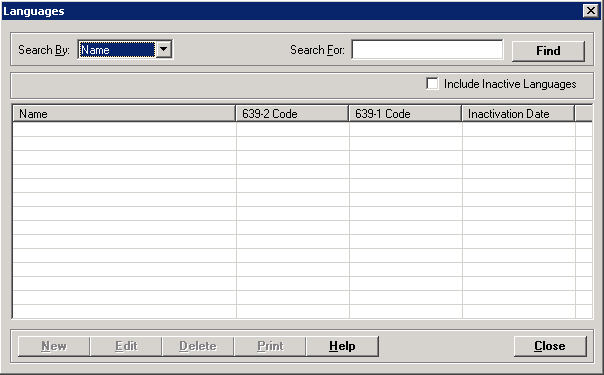
To access the Languages window, go to Patient Registration > Master Files > Codes > Languages. [+]
The following tasks can be performed from this window:
Users should never be allowed to add or delete a language code as the listing is a predefined set of valid values. User security should be set up to restrict access to this master file.
To display all language codes on file, click Find without entering any search criteria. The grid displays the language codes by Name in alphabetical order. You can click any column heading to sort the list based on that column. Click the column heading again to reverse the order (i.e., ascending or descending).
Change or narrow your search results by entering specific search criteria:
In the Search By field, use the drop-down list to select how you want to search the list and sort the results. Select from the following sort options: 639-1 Code, 639-2 Code, or Name.
In the Search For field, enter the specific term to search for based on the Search By field choice. Enter all or part of the term to retrieve all records that match the criteria.
Check the Include Inactive Languages box to include inactive codes in the search results.
Click Find to display the search results in the grid.
DO NOT add a language code unless directed by Centriq staff.
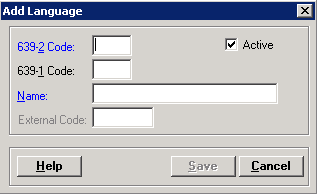
Click New at the bottom of the Languages window. The Add Language window is displayed. [+]
In the 639-2 Code field, enter the 3-character code for the language.
In the 639-1 Code field, enter the 2-character code for the language.
In the Name field, enter the name of the language.
The External Code field is enabled if you are a Classic Financial + Centriq site. This field displays the 3-digit language code that is passed from the Classic Patient Management application.
Check the Active check box to indicate that the language is available for use in the Centriq system. Uncheck the box to make the language unavailable/inactive.
Click Save to save the language code and close the window, or click Cancel to close the window without saving.
The Edit button allows you to changed the active/inactive status of a language. DO NOT edit the codes or description unless directed by Centriq staff.
In the Languages window, find and select the language code that you want to edit.
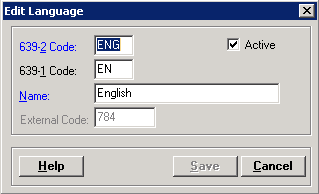
Click Edit. The Edit Language window is displayed. [+]
Check the Active check box to indicate that the language is available for use in the Centriq system. Uncheck the box to make the language unavailable/inactive.
Click Save to save your changes and close the window, or click Cancel to exit without saving.
DO NOT delete a language code unless directed by Centriq staff.
In the Languages window, find and select the language code that you want to delete.
Click Delete. A verification message is displayed.
Click Yes to delete the language code, or click No to keep it.
Follow the instructions below to display and/or print a list of language codes on file.
In the Languages window, choose your search criteria and click Find to display the language codes that you want to print. All records that are visible in the grid will be included in the report.
Click Print. The report is displayed in the Report Viewer where you can save the list to the PC/network or print the list to an assigned printer. See To preview the report for more information on options within the viewer.